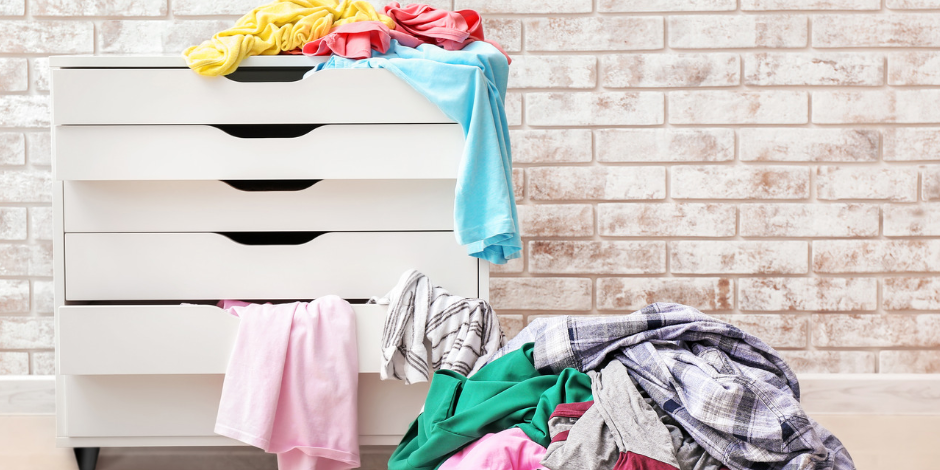
Have you ever opened a cupboard and had something tumble out? Or pulled open a drawer only to find that you can’t actually reach the things you need because something has been shoved in the front?
I call this “blocking.”
Blocking happens when items are placed at the front of a cupboard, on top of other things, or in the most accessible part of a drawer, preventing you from easily getting to what’s behind them. It’s often a sign that a space has reached its limit.
The funny thing is that blocking doesn’t usually happen deliberately. It tends to creep in gradually.
Maybe you’ve come home with a few new purchases and haven’t really thought about where they’ll live. Perhaps you’re in a rush and quickly push something into the nearest available space, promising yourself you’ll sort it out later. Or maybe you’ve spent ages organising a cupboard, only to discover there’s still a pile of items left over and, if you’re honest, your enthusiasm for the task has completely disappeared!
So, you squeeze the remaining bits in wherever they’ll fit.
We’ve all done it.
Blocking can also happen outside our storage spaces. Think about items piled in front of cupboard doors, boxes stacked in front of drawers or things left on the floor that make it difficult to open a wardrobe or access a storage unit. When we have to move things out of the way just to get to what we need, it’s another form of blocking.
Our storage should be accessible and easy to use. If getting to something feels like hard work, there’s a good chance the system isn’t working as well as it could.
The problem is that blocking creates a domino effect. Once one item is blocking access, you stop using the space properly. You forget what you already own because you can’t see it. You buy duplicates because the original item is hidden. Putting things away becomes more difficult, so items end up on worktops, tables and other surfaces instead.
Before you know it, the clutter begins to spread.
I often see blocking in kitchen cupboards, bathroom cabinets, wardrobes and paperwork drawers. It’s one of the biggest clues that a storage system isn’t quite working anymore.
The good news is that blocking is usually easy to fix.
Start by asking yourself a few questions:
- Does this space simply contain too much?
- Have I added more items without creating room for them?
- Is there anything here I no longer need or use?
- Are my most-used items easy to access?
Ideally, every item should have enough space to be stored without preventing you from reaching something else. Your home should work for you, not against you.
The next time you open a drawer or cupboard, have a look and see if there’s any blocking going on. You might be surprised by how often it appears.
And if you spot it? Don’t just move the item to another space and create a new block elsewhere. Take it as a little signal that it’s time to reassess, declutter and make some room to breathe.
Sometimes the biggest obstacle to getting organised isn’t a lack of storage at all. It’s simply that one extra item that has nowhere to go.
Caroline xx
Giving you the confidence to let go